
Shackelford County Sex Offender Checks
The Texas Public Sex Offender Registry is the main public search channel for Shackelford County sex offender records. Texas Department of Public Safety, or DPS, manages the statewide system under Code of Criminal Procedure Chapter 62. Local agencies maintain registrations and send required data to DPS. Start with the public registry because it can search the county as a whole, a named place such as Albany or Moran, a street area, or a person. The county does not publish a separate official local registry portal.
Before searching, gather more than a name when possible. An address, city, ZIP code, photograph, age, or physical description can help separate people with similar names. A map result shows location context, while a name result is better when the person is known but the address is not. Neither route should be treated as proof that an unlisted person has no duty to register. Public display can be limited by law, and data changes as local authorities verify new information.
For the official interface itself, the DPS registry search page shows the current search modes and controls.
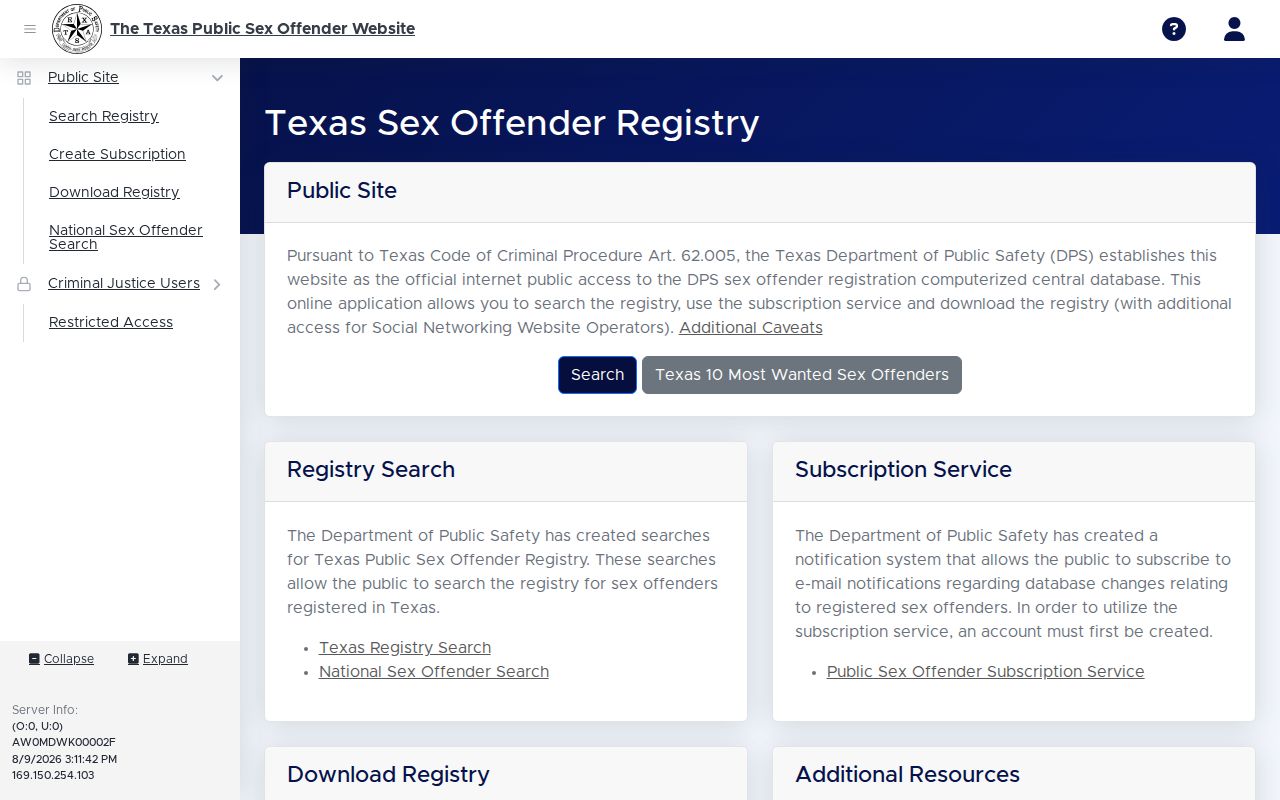
The live DPS screen is the right place to confirm current options before relying on a Shackelford County registry result.
Shackelford County Registry Contacts
Texas assigns registration to city law enforcement when a registrant lives within a city and to county law enforcement when the person lives outside one. No verified Albany or Moran registry-office page was found in the county research. The official county directory is the local starting point for confirming the current office. Anyone who needs registration instructions should verify the correct authority instead of assuming that every address uses the same desk.
For an address in unincorporated Shackelford County, contact the Shackelford County Sheriff’s Office at 791 West U.S. Highway 180, Albany, Texas 76430, or call 325-762-9500. The same office is the documented route for reporting suspected noncompliance outside a verified city program. Give the location and facts that prompted the concern. Do not approach or confront the person.
Shackelford County Sheriff’s Office
791 West U.S. Highway 180
Albany, TX 76430
325-762-9500
Note: The sheriff is the verified rural contact, but city residents should first confirm which local authority maintains their registration.
Texas Public Sex Offender Registry Searches
DPS offers distinct routes for a Shackelford County sex offender lookup. Use the name mode for a known person, the address mode for a specific location, or geographic controls for community awareness. County filtering is especially useful here because only Albany and Moran are incorporated cities and much of the county is rural. Read the live form’s conditions and field prompts before submitting a search.
- Open the DPS public registry and review its conditions of use.
- Choose a name, address, city, ZIP, county, or map search. Select Shackelford when using the county control.
- Compare the result list with available identifiers instead of relying on a matching name alone.
- Open the full profile and review the offense, address type, registration status, risk information, and dates shown.
| Field Label | Type | Required | Notes |
|---|---|---|---|
| Name Search | Search mode | No | Use first and last name fields as the live form directs. |
| Address Search | Search mode | No | Search by street, city, or ZIP where supported. |
| City | Text or selection | Mode-dependent | Use Albany or Moran when the address is within a city. |
| County | Selection | No | Select Shackelford for a countywide result set. |
| Map Search | Interactive map | No | Use for visual area review; inspect live radius choices. |
| Notifications | Account or signup | No | Follow the current DPS prompts for available notices. |
The controls can change as DPS updates the service. A blank or narrow result is a reason to recheck spelling, search mode, and geography, not proof that no relevant registry record exists.
Shackelford County Registry Search Modes
A map search and a name search answer different questions. The map is suited to neighborhood awareness near a home, school route, park, or regular destination. A name search follows one identity even if the person’s location has changed. In a county spanning more than 900 square miles, city-only searches can miss rural locations, so the county filter or map view can add useful reach.
Location is still not identity. Map points should be opened and checked against the profile, and a name match should be compared with physical details, aliases, and the reportable offense. If an address looks stale, use the listing’s current status and contact the proper registration authority. Do not publish accusations or try to verify the address in person.
Registry Profiles: What They Show
A Texas registry profile combines identity, location, offense, and registration details that Chapter 62 permits DPS to display. It may show a photograph, aliases, physical traits, an address or location type, risk information, and whether the registration appears current. Read every field in context. The conviction or adjudication field describes the reportable offense, while the status fields address registration. Neither is a live court docket.
| Name and Aliases | Identifying names used to distinguish the listed person. |
|---|---|
| Photo and Description | Photograph plus public traits such as sex, race, height, weight, hair, eyes, scars, marks, or tattoos. |
| Registered Location | Residence information and address type as DPS is authorized to display. |
| Offense and Statute | Reportable offense, legal citation, date, and jurisdiction shown in the public record. |
| Risk Information | Low, moderate, or high assessment information where one is assigned. |
| Registration Status | Public status, verification details, and registration term information where calculated. |
| Other Public Fields | Registry identifier, specified vehicle data, or school and institution association when legally public. |
Texas excludes Social Security numbers, driver-license numbers, phone numbers, online identifiers, employer details, and victim-identifying information. Some juvenile registration information can also be made nonpublic by court order. Those limits protect sensitive data and explain why a public profile is not a full government file.
The DPS registration program overview explains the state and local roles behind those public fields.
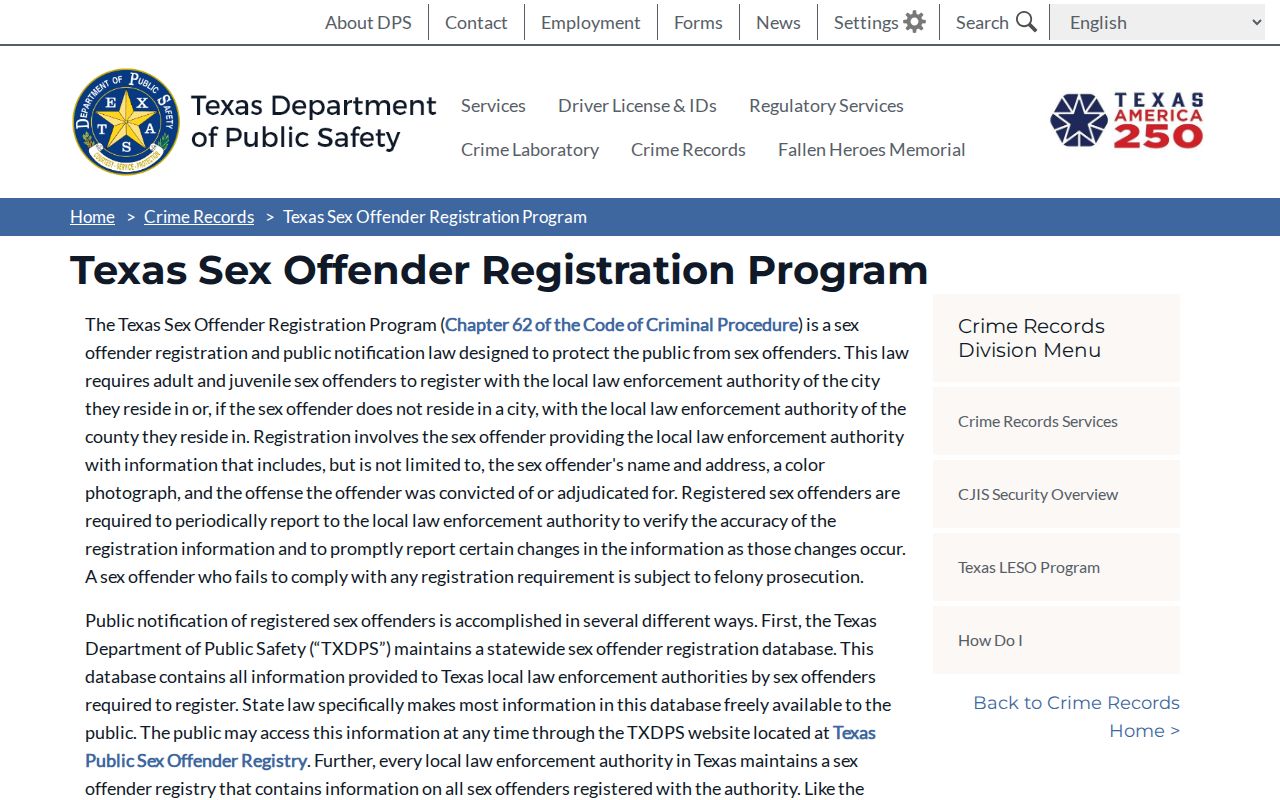
The program page helps connect a public Shackelford County profile to the registration and notification duties that produce it.
Stale Shackelford County Registry Addresses
An address that appears old should be reported through official channels. Check the profile status, verification details, and any update date first. Then contact the registration authority tied to the location. For an unincorporated Shackelford County address or when no verified city office can be found, use the official sheriff contact or call 325-762-9500. Supply the profile identifier and the factual reason for concern if available.
Do not visit the address, question neighbors as though a violation is proven, or confront the listed person. An apparent mismatch can reflect a recent move, display timing, an address type, or another lawful circumstance. The registering agency can compare public information with records that are not open online and determine whether follow-up is needed.
Report facts, not assumptions. Give the sheriff or proper city authority the location, registry identifier, and observed discrepancy, then let that agency investigate.
Registration Levels and Duties in Texas
Texas risk levels and registration periods are separate concepts. DPS may display low, moderate, or high risk where an assessment has been assigned. Those terms are not the federal SORNA Tier I, II, and III labels, and they do not by themselves set a ten-year or lifetime duty. Duration depends on the reportable offense and the provisions of Texas Code of Criminal Procedure Chapter 62.
| Texas Concept | Duration | Verification |
|---|---|---|
| Risk level | Does not set the term alone | Frequency depends on the statutory category |
| Ten-year duty | Ten years after the applicable release or supervision endpoint for designated offenses | As Chapter 62 requires for the category |
| Lifetime duty | Life for designated serious or repeat reportable offenses | As Chapter 62 requires for the category |
| Juvenile or modified duty | Controlled by the court order and statute | May differ or be nonpublic |
Registrants must also report required changes promptly. Verification frequency varies by statutory category, so a reader should use the profile and Chapter 62 rather than infer a schedule from the risk label. The full conviction and order control the duty.
Shackelford County Registry Notifications
Public website access is one part of Texas community notification. DPS materials describe notifications through the registry service, and state law also provides for local notice, school notice where required, authorized publication, and mailed postcards in specified high-risk cases. The postcard process applies when a high-risk registrant or a civilly committed sexually violent predator moves into a community. It should not be read as the only way the public learns of a change.
Use the current DPS notification prompts to learn what signup options are available for a Shackelford County address. Keep the search area broad enough for rural roads and locations outside Albany or Moran. A notice is a cue to read the source profile, confirm the displayed address and status, and make calm safety plans. It is not a finding that a new offense occurred.
Note: Notification methods depend on statutory category and location, so absence of a postcard does not establish that no registry record exists.
Shackelford County National Registry Searches
The National Sex Offender Public Website, or NSOPW, adds a cross-state layer. It is useful when a person may have moved beyond Texas or when a safety search spans more than one jurisdiction. NSOPW does not replace the Texas source record. It routes users to data supplied by participating jurisdictions, so a Texas result should still be read on the DPS profile.
The national site is broader, while the Texas registry offers state-specific fields and local registration context. Search both when the location history crosses a state line. For a search confined to Shackelford County, start with DPS and use NSOPW as a second check rather than treating duplicate results as separate people.
The official NSOPW search shows the national scope and directs users back to source jurisdictions.
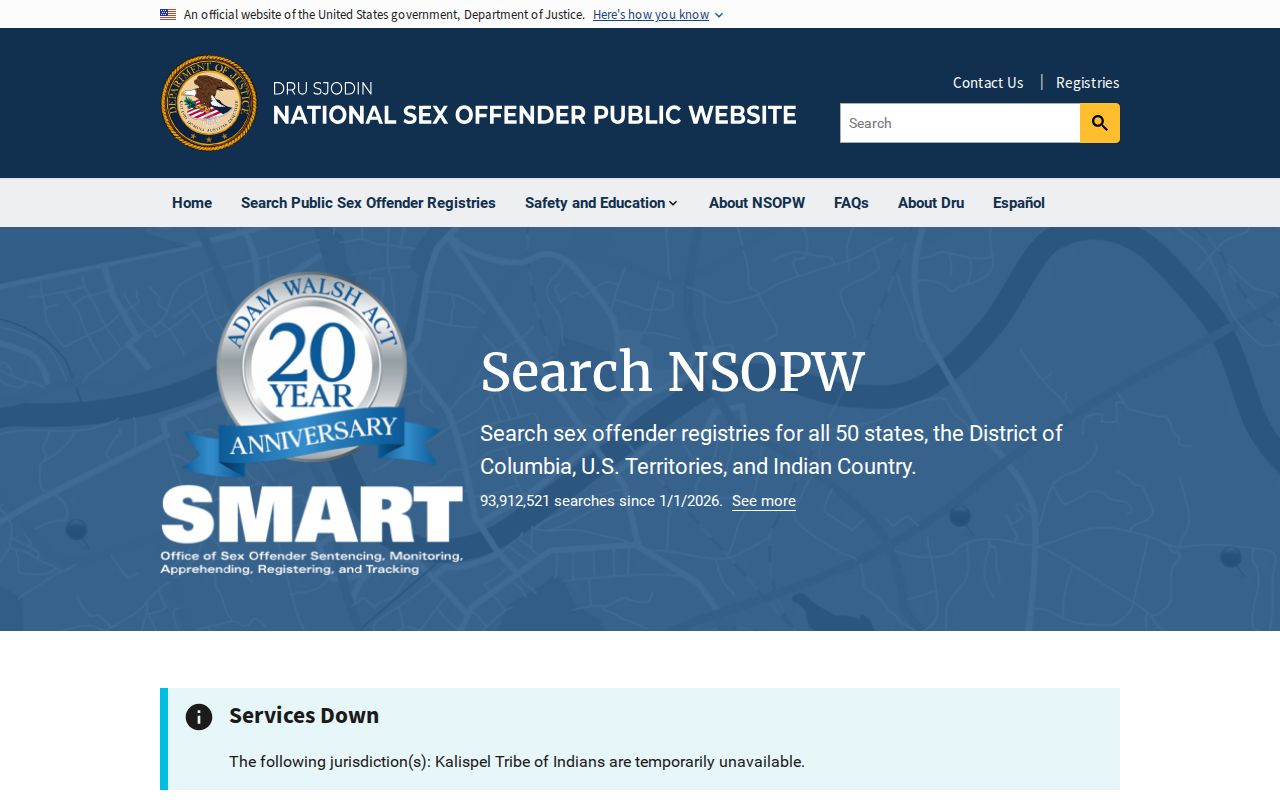
That wider search is most valuable when a Shackelford County safety check must account for an address or registration history outside Texas.
Using Registry Information Lawfully
Registry information exists for community awareness and safety planning. Texas notification can occur through the DPS website, local registries, authorized publication, school notice where required, and mailed DPS postcards when a high-risk offender or a civilly committed sexually violent predator moves into a community. DPS also advertises notification functions through its current registry service. Follow the live signup prompts because interface details can change.
Use a Shackelford County sex offender lookup to understand a public profile, plan family safety, or identify the right agency for a concern. It is not permission to threaten, shame, follow, or harm anyone. Suspected noncompliance belongs with the sheriff or the proper city registration authority. An emergency should go to emergency services.
Misuse can be a crime. Texas DPS warns that registry information must not be used to injure, harass, threaten, or commit a crime against a listed person or household. Chapter 62 governs lawful public access and registration duties.
Community notice and a public profile do not transfer enforcement power to the public. Verify the current record with DPS, report a concrete concern through law enforcement, and avoid direct action.